Africa Deserves Leadership That Does Not Dreams But Dares; Not Only Commands, But Serves – Wike
BY OUR REPORTER
The Federal Capital Territory, ( FCT) Minister, Nyesom Wike has reflected on the Africa’s present moment, saying
the Continent today stands at a historic crossroads. This is as he declares that the Continent deserves Leadership that does not dreams but dares; not only commands, but serves, not only governs but transforms.
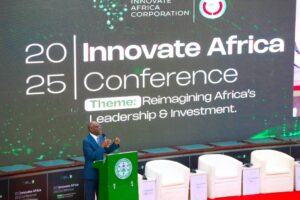
Wike made this known on Thursday in Abuja while delivering his keynote address at the 2025 Innovate Africa Conference.
Wike said Africa is endowed with immense natural wealth, fertile lands, vibrant cultures, and the youngest population in the world.
He said “We are a continent of extraordinary promise, alive with creativity, innovation, and a deep cultural heritage that has shaped humanity itself. Yet, on the other hand, we continue to grapple with weak institutions, infrastructural deficits, widespread unemployment, poverty, and recurrent governance failures that have constrained our progress.
“This is the paradox of our age: how can a continent so richly blessed remain so constrained? How can such abundance coexist with scarcity, such youthful energy be stifled by joblessness, such sovereignty be undermined by fragility?”. ‘
Wike said this tension defines Africa’s present moment, a moment of both urgency and immense possibility.
He said at the heart of this paradox lies the decisive factor of leadership.
” Leadership remains the fulcrum upon which the destinies of nations turn. It determines whether our vast resources become a blessing or a curse; whether our diversity becomes strength or division; whether our challenges become stumbling blocks or stepping stones.
“When leadership is visionary, accountable, and courageous, even the most daunting obstacles can be transformed into opportunities.
“But leadership must also create the enabling environment for transformation by providing the critical infrastructure that attracts investment, drives productivity, and sustains growth.
“At present, the level of investment in Africa remains minimal precisely because of infrastructural decay and policy inconsistency. Roads, power, railways, and digital connectivity are the arteries through which development flows; without them, the economy cannot freely breathe. It is to be deeply regretted that Africa continues to export raw materials and import finished goods, a cycle that perpetuates dependency and stifles industrial growth. This situation is unhealthy for sustainable development, which has eluded the continent for far too long”, he said.
Wike said Africa’s future will be written by the kind of leadership it nurture today, saying it needs leadership that not only dreams, but dares; not only commands, but serves; not only governs, but transforms.
Speaking on reimagining Africa’s Leadership in the 21st Century, Wike said to secure Africa’s future, “we must first reimagine leadership itself”.
He said the time has come to move beyond transactional leadership, the kind driven by personal gain, patronage, and short-term calculations, to embrace transformational leadership rooted in vision, courage, service, and accountability, saying Leadership must not exploit, but empower; it must not rule, but serve; it must not merely transact, but transform.
He said many commentators agree that the greatest impediment to Africa’s progress and the chronic ailment that has stifled her development for decades is the plague of poor and mediocre leadership.
His words : “Across the continent, both in military and civilian dispensations, leaders have often emerged through self-serving conspiracies that bear little or no relation to national interest or development priorities.
“Consequently, many African nations have been saddled with leaders unprepared for the enormity of leadership. The result is a tragic pattern of groping in the dark, with nations endlessly experimenting with the fundamentals of development: basic infrastructure, primary healthcare, functional economies, efficient democratic and judicial systems, and credible institutions”.
Wike said the 21st century calls for a new kind of African leaders who are prepared, principled, and passionate. “Leaders who embody vision, moral character, and resilience.
“Leaders who believe in Africa’s boundless possibilities and act decisively to unlock them. They must be bold enough to make difficult but necessary decisions; proactive enough to anticipate the future; and committed enough to build systems that prioritize excellence over mediocrity and performance over politics.
“The leadership that Africa deserves in the 21st century is one that is about caring rather than controlling. A true leader must see himself as a servant, humbled by the weight of responsibility he carries for the welfare of the people. Africa is in urgent need of servant-leaders—leaders who do not see themselves as bosses but as mentors genuinely committed to the building of communities and the upliftment of people.
“Transformational leadership is not an abstract ideal; it is a living reality where bold vision meets purposeful action. Here in Abuja, we have witnessed how infrastructural renewal anchored on political will and strategic investment can turn aspiration into achievement. Roads that were once impassable are now open; bridges connect communities; public spaces once abandoned now thrive with life, enterprise, and hope. These are not mere structures of concrete and steel; they are symbols of what is possible when leadership dares to dream and to deliver”, he said.
Wike said President Bola Ahmed Tinubu’s commitment to difficult but necessary reforms further reminds everyone that leadership is ultimately about sacrifice for the greater good.
He said ” From the first day of his presidency, Tinubu demonstrated uncommon courage by confronting one of Nigeria’s most intractable challenges, the removal of the fuel subsidy. While previous administrations acknowledged its dangers, none dared to act. Tinubu did, understanding the cost but believing in the long-term gain.
“Today, this bold decision is beginning to yield results: states and local governments now receive higher revenues for development; the burden of debt accumulation is easing; and the price of petrol is gradually aligning with market realities under sound regulatory oversight.
“Equally transformative is his effort to decentralize governance and address the structural imbalance of over-centralization. Through the creation of zonal and regional commissions, President Tinubu is devolving development closer to the people, an essential step toward genuine federalism. In the area of security, his administration has invested in the training and retraining of the armed forces and approved the recruitment of forest guards nationwide to reclaim ungoverned spaces from bandits and terrorists. These and other strategic measures are repositioning Nigeria toward stability, productivity, and growth.
“Yet, it must be emphasized that no leader, however visionary or determined, can succeed without the support and cooperation of the people. The burden and glory of national transformation must be shared. History teaches us that no nation progresses without synergy between its leadership and followership. Dubai, for example, attained global prominence through the unity of purpose between a decisive leader and a believing people, for, as Yasar Jarrar observed, “Dubai had a leader who acted quickly and decisively, not shaken by challenges, and had his people backing him and believing in his vision.”
“If we can reimagine leadership across Africa in this same spirit—leadership that builds, not blames; that inspires, not divides; that empowers, not dominates—then no mountain will be too high, no challenge too great, and no dream too ambitious for our continent. The time for belief is here; the time for action is now. Together, with visionary leadership and a committed citizenry, Africa can begin to realize the continent of its dreams”.