Olukoyede And The Fight Against Corruption With Sincerity And Ingenuity
BY AYO ESAN
It is an incontrovertible fact that corruption remains a persistent and pervasive challenge in Nigeria. For years it has been undermining the country’s development efforts and eroding public trust in governance institutions.
Though there were concerted efforts by successive administrations to tackle this menace, recent events have put into the front burner, the daunting task ahead in the fight against corruption.
The country has been consistently ranking poorly on global corruption indices, but the current administration of President Bola Ahmed Tinubu has pledged its determination to tame the corruption menace.
From embezzlement of public funds to bribery and extortion, corrupt practices have plagued all levels of society and hindering economic growth.
Recent revelations have further exposed the depth of corruption in Nigeria, with high-profile cases involving current and past government officials as well as business leaders, and institutions.
The mismanagement of public resources and the diversion of funds meant for critical infrastructure projects have become all too common, depriving ordinary Nigerians of essential services and opportunities for advancement.
Despite the establishment of the anti-corruption measures and the establishment of dedicated anti corruption agencies such as the Economic and Financial Crimes Commission (EFCC) and the Independent Corrupt Practices and Other Related Offences Commission (ICPC), significant challenges still persist in the fight against corruption.
Among the primary obstacles is the lack of political will to prosecute and punish corrupt individuals, particularly those in positions of power.
A Social Commentator , Comrade Paul Obiaku has listed political interference, judicial delays, and weak enforcement mechanisms as factors that often hampered efforts to hold perpetrators accountable, allowing impunity to thrive.
He also mentioned, entrenched systemic issues, such as opaque procurement processes, weak regulatory frameworks, and a culture of impunity as factors that had continued to facilitate corrupt practices.
Addressing these structural deficiencies requires comprehensive reforms and sustained commitment from all stakeholders.
A fresh report released by the National Bureau of Statistics has indicated that N721bn was received as bribe by Nigerian public officials in 2023.
The report titled, “Corruption in Nigeria: Patterns and Trends”, was released by NBS recently.
According to NBS, the N721bn paid in bribes across the country in 2023 amounted to about 0.35 per cent of the country’s Gross Domestic Product, GDP.
The report which was based on a survey conducted with the United Nations Office on Drugs and Crime, stressed that the average cash received by public office holders in 2023 was N8,284, an increase from an average of N5,754 in 2019.
The report read in part, “According to the 2023 survey, the average cash bribe paid was 8,284 Nigerian Naira.
“While the nominal average cash bribe size increased since 2019 (from NGN 5,754), this does not account for inflation. The inflation-adjusted average cash bribe in 2023 was 29 per cent smaller than in 2019 in terms of what could be bought with the money.
“Overall, it is estimated that a total of roughly NGN 721 billion (US$1.26 billion) was paid in cash bribes to public officials in Nigeria in 2023, corresponding to 0.35 per cent of the entire Gross Domestic Product of Nigeria.”
Recent corruption scandals have once again brought the issue into the spotlight, sparking public outrage and calls for decisive action.
The alleged misappropriation of funds meant for COVID-19 relief efforts, revelations of inflated contracts, and instances of bribery and kickbacks have elicited widespread condemnation and demands for accountability by Nigerians
The brazen nature of these scandals, coupled with their detrimental impact on the lives of ordinary Nigerians, has awaken the civil society, the media, and the international community to demand greater transparency and accountability from government officials and institutions.
From the aforementioned, there is no gainsaying the fact that the scourge of corruption has brought Nigeria to its knees, from economic underdevelopment to socio-political decadence.
Over the years, Nigeria have had leaders who promised to end the plague, but corruption ended up strangling their resolve. A good example being the former president, Muhammadu Buhari, who used the mantra “kill corruption before it kills Nigeria” to ascend to office; but the irony and the tragedy is that during his tenure corruption morphed into a hydra-headed monster.
Most of the past Chairmen of the anti corruption body , the EFCC have also came out of offices with stains on their white apparels.
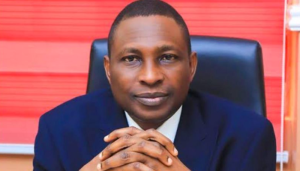
But on October 12, 2023, Ola Olukoyede, a Lawyer who has also served as a Secretary to the commission was named as the new EFCC Chairman by President Tinubu and was screened by the Senate on the 18th of October 2023.
Like a well prepared General going for war, Olukoyede impressed the senators during the screening .
He told the country’s senior national legislators that: ”the time has come for us to begin to look at more of prevention than enforcement.
“Enforcement is a very strong tool in our hands, we are going to apply it very seriously”.
He also pointed out that the anti-corruption war will bite harder with a transactional credit system, arguing that, “if we allow Nigerians to continue to buy houses and cars with cash, a thousand EFCC, added to a million ICPC will not do us any good”.
The new EFCC’s boss also called for greater improvement in the criminal justice system, stressing that, “if we really want to fight corruption…..we must encourage our criminal justice system to adjudicate in such a way that, maximum prosecution doesn’t take more than five years. If we make our criminal justice system works, you will see more of what the anti-corruption agencies are doing and it will be better for all of us”.
The Senate, impressed by the articulation of Olukoyede’s initiatives in driving the anti-corruption war more vibrantly, confirmed his appointment as a substantive Executive Chairman of the EFCC.
The new EFCC chairman definitely must have studied the mood of Nigerians when he declared within a few days of his assumption of office that anti-corruption fights should be premised on initiatives and modalities capable of stimulating economic growth and development in the overall interests of Nigerians.
In particular, the new Sheriff came with a clear-cut agenda of re-positioning and re-focusing the Commission for optimal effectiveness.
Olukoyede, brought to the fore, his experience as a principal officer in the commission and well meaning Nigerians quickly realized that he is not only a tested hand but a disciplined man who has an unblemished record of performance.
Speaking while addressing officers of the Lagos Zonal Command in Lagos on Tuesday, November 7, 2023, Olukoyede said, “There is need to redirect our focus towards what we were set up to do in Nigeria, which is to drive economic development. We will tilt our focus towards that area. We will work to drive economic development, create wealth and employment”.
His pledge that the commission would look into the mix-fund rules that separate proceeds of crimes from legitimate money so as to allow businesses to grow was well appreciated by Nigerians and will rewrite the name of the commission in gold.
It is a matter of time that EFCC would have helped, in line with its mandate, makes conscious efforts to redeem the image of the country in the global community.
This is one measure that will tell the whole world that the anti-graft agency is ready to do the needful and put Nigeria among the comity of nations.
Also his promise that the agency would collaborate with other stakeholders to re-write the country’s history will go a long way in boosting not only Nigeria’s image but will encourage foreign direct investments (FDI) to impact positively on our ailing economy.
As Olukoyede marches on in his determination to be the change agent, Nigerians want him to remember his promise that the Commission will uphold the core values of the EFCC which include integrity, courage, professionalism and collaboration in the discharge of its duties in order to justify its engagement.
Another thing that would interest the progressive-minded Nigerians and potential investors is the new helmsman promise that the anti-corruption drive must open up an atmosphere of accountability and transparency in the country.
As a way of demonstrating his seriousness, Olukoyede, who promised to use the instrumentality of the law to preside over the affairs of the agency, enjoined the EFCC staff in a recent event that they must be professional in all they do. “Our image should reflect our core values. I have been part of this system. I was out for three years and I know the way things are”, he told the staff.
The new EFCC chair won the hearts of many Nigerians when he tasked officers and men of the Commission to be above board and insisted that asset declaration is compulsory for every staff.
It is instructive to note that while given the directives, Olukoyede informed Nigerians that he had declared his asset, stressing that all staff should declare theirs too.
As promised by Olukoyede, the job will be half done if he can keep his promise on the three focal areas already identified and raises three posers as important thrusts of plying his new job. The three focal areas are : focus on the mandate of the EFCC, pursuit of transparency and accountability and building the image of Nigeria. To achieve these, he has dwelt on the need for collective responsibility, greater emphasis on preventive frameworks against graft and premium attention on transactional credits.
Looking at the task ahead and the need for total commitment from all, Olukoyede also stated recently that, “We must come together and believe that, with the way financial crimes have overwhelmed our structures and systems in Nigeria, we can’t move forward and if we move forward, it will be at a snail speed…The time has come for us to show commitment”
He reinforced his conviction that the task of fighting corruption is a fight that must catches the attention of all Nigerians.
Olukoyede while addressing stakeholders recently at the Unity Fountain in Abuja to commemorate the 2024 African Anti – Corruption Day said apart from terrorism, corruption is the next deadliest affliction of humanity.
He said most of the governors being prosecuted today were those who couldn’t pay minimum wage.
He asked Nigerians to embrace whistleblowing by exposing corruption in the country.
He called for enhanced and consistent commitment to whistle blowing by Nigerians to tackle the menace of economic and financial crimes and other acts of corruption.
He said: “Aside terrorism, corruption ranks as the next deadliest affliction of humanity in every region of the world.
“In view of the danger and threat to our existence which corruption represents, it is imperative that individuals, communities, corporate bodies and indeed the whole world join hands to tackle it frontally.
“ One way of doing this is through the whistle-blowing initiative”.
Olukoyede said the fight against corruption required absolute commitment to integrity and unfaltering focus.
“We cannot win the war against corruption through lip service, emotional outburst or mere mob campaigns.
“There is need for commitment, passion, consistence and credibility of intelligence. Every whistle blown must point towards truth and evidential proofs”, he said.
He pleaded with the Nigeria Labour Congress and Civil society organizations to be part of the anti-graft war.
One cannot but agree that addressing corruption in Nigeria requires a multi-faceted approach that encompasses legal, institutional, and cultural reforms. Strengthening anti-corruption laws, enhancing transparency in public procurement processes, and strengthening the capacity of anti-corruption agencies are essential steps in the right direction.
Above all, combating corruption requires unwavering political will and a commitment to upholding the rule of law. Government leaders must lead by example, demonstrating their dedication to transparency, accountability, and the equitable distribution of resources. Nigeria’s battle against corruption is far from over, but recent events show the urgent need for decisive action. By confronting systemic challenges, holding perpetrators accountable, and fostering a culture of integrity and transparency, Nigeria can begin to turn the tide against corruption and pave the way for a corrupt free country. The time for action is now.
Looking at the effort of the EFCC under Olukoyede one cannot but agree that he is set to assist Nigeria remove or lessen the scourge of corruption.
Olukoyede’s efforts had not gone unnoticed as he was conferred with honour as Nigeria foremost Anti graft champion on July 6, 2024 at the Nigeria Excellence Awards in Public Service organised by the Best Strategic PR, TBS in collaboration with the Office of the Secretary of the Federation.
As he forges ahead , Olukoyede will definitely needs the support of all Nigerians to succeed.